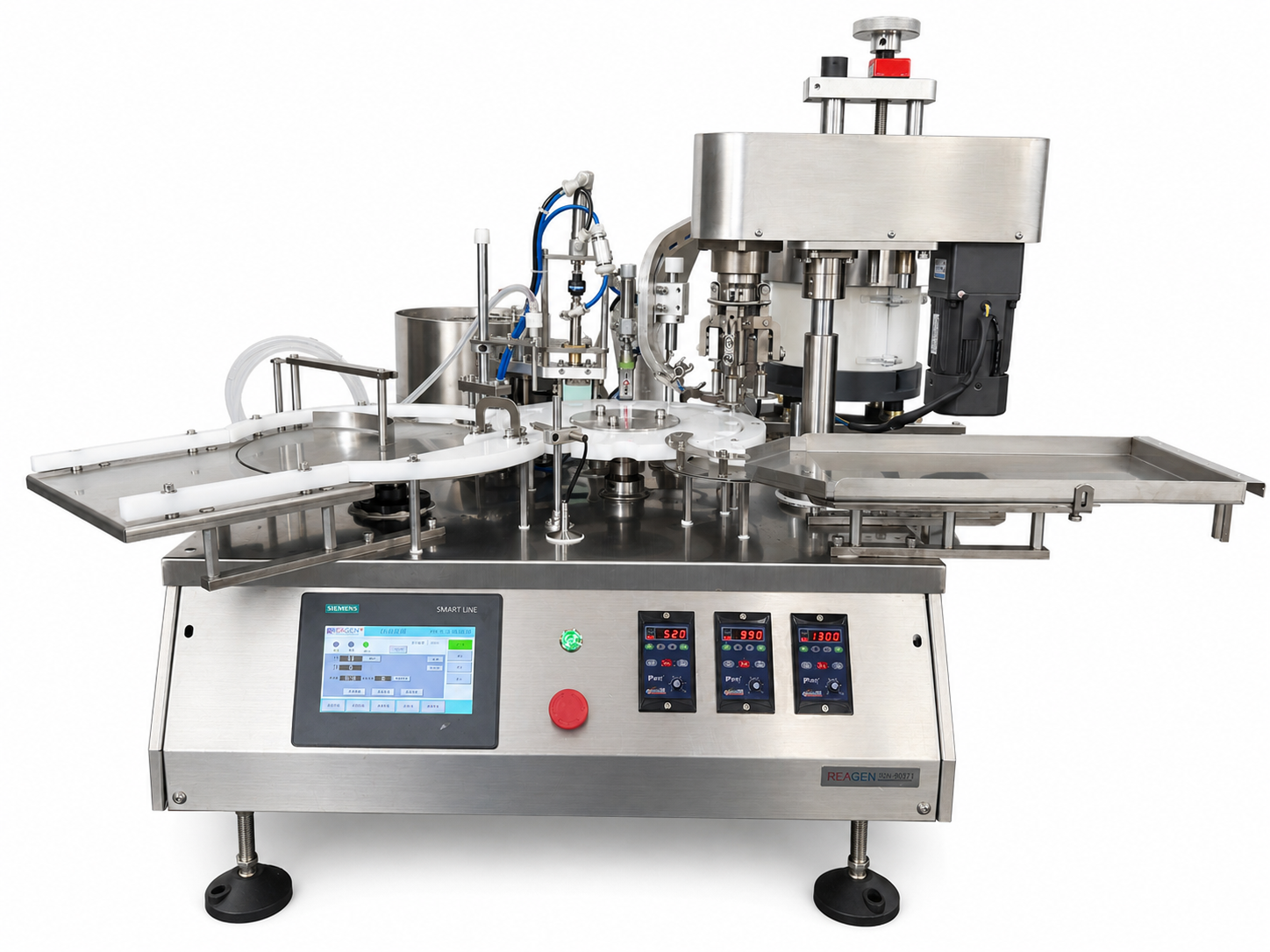
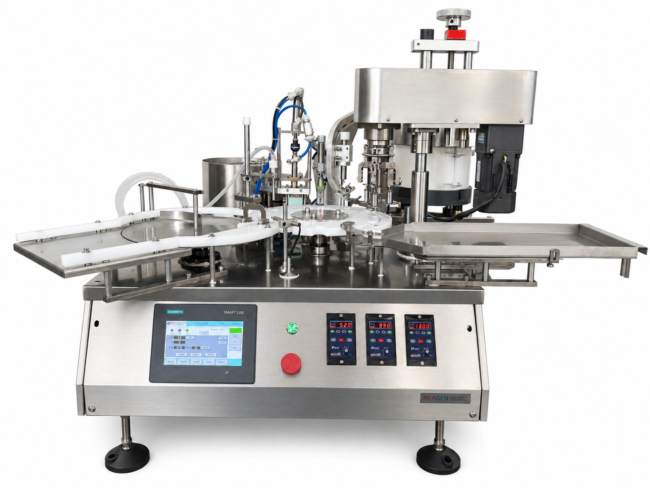
- Bottle tray
The bottles are sorted and conveyed one by one into the main turntable, where they are stored in the waiting area.
- Peristaltic pump
Driven by a stepper motor, the filling volume needs to be set and adjusted via the touchscreen. The pump tubing is a consumable part and needs to be replaced according to actual usage.
- Fluid filling support
The filling needle lifting mechanism then guides the material into the bottle, requiring adjustment based on the bottle’s height.
- Inner plug vibratory plate
The material inside is aligned in a specific direction for feeding.
- Upper inner plug mechanism
The inner stopper, prepared by the vibratory feeder, is then vacuum-adheded and pressed onto the bottle neck.
- Internal plug detection probe
The bottle being filled is memorized at this position for internal stopper detection.If no sensor detects it, an alarm is triggered.
- Pressure-reducing mechanism
Press the inner stopper again until it is completely pressed onto the bottle neck.
- Upper outer cover mechanism
The outer cap, after being shaped by the vibrating plate, is mechanically pressed onto the bottle neck.
- Outer cover detection probe
The bottles on the rotating platform are memorized at this position, and the outer cap is detected. If no sensor detects the cap, an alarm is triggered.
- Outer cover vibrating plate
The material cover is aligned in a specific direction before feeding.
- Rolling cap mechanism
The cap is pressed in place by rotating the motor; adjustments need to be made according to the specific details of the cap.
- Discharge conveyor belt
The finished product is fed into the conveyor belt through the bottle-dispensing mechanism and flows out.
- Main turntable
The main mold carrier for bottle operation
- Speed controller
Depending on the specific operating effect of the bottle, the motor speed can be adjusted.
- Perform detection probe
The bottles entering the turntable are then tested and memorized.
- Touchscreen
Equipment operating parameters and manual operations for various processes can all be controlled via the touchscreen. If an alarm is triggered, the cause of the alarm can be identified, and the equipment’s operating status can be monitored.